Why does fetch make you wait twice?
The two awaits
const response = await fetch('/api/pokemon');
const data = await response.json();
Why the second one?
We already have our response
Right?
const data = await response.json();
JSON.parse does ~170 MB/s.Parsing isn't the bottleneck.
const data = JSON.parse(myJsonString);
.text() 🏃 and .blob() 🚀
							const text = await response.text();
							const blob = await response.blob();
✨Response✨
Object
							const response = await fetch("/api/pokemon");
							const text = await response.text();
							const json = await response.json();
							const blob = await response.blob();
							const response = await fetch("/api/pokemon");
							console.log(response);
							ok: true
							status: 200
							statusText: ""
							headers: Headers {}
							url: "/api/pokemon"
							type: "basic"
							redirected: false
							body: ReadableStream
							bodyUsed: false
HTTP Request
const response = await fetch("/api/pokemon");
							GET /api/pokemon HTTP/1.1
							Host: fetch-server.fly.dev
							Accept: application/json
HTTP Response
							HTTP/1.1 200 OK
							Content-Type: application/json
							Content-Length: 214016

							[{
								"id": 1,
								"name": {
								"english": "Bulbasaur",
								"japanese": "フシギダネ"
								},
								"type": ["Grass", "Poison"],
							...
							... much more data ...
The important bit!
fetch returns as soon as headers have
arrived
The body could still be on its way
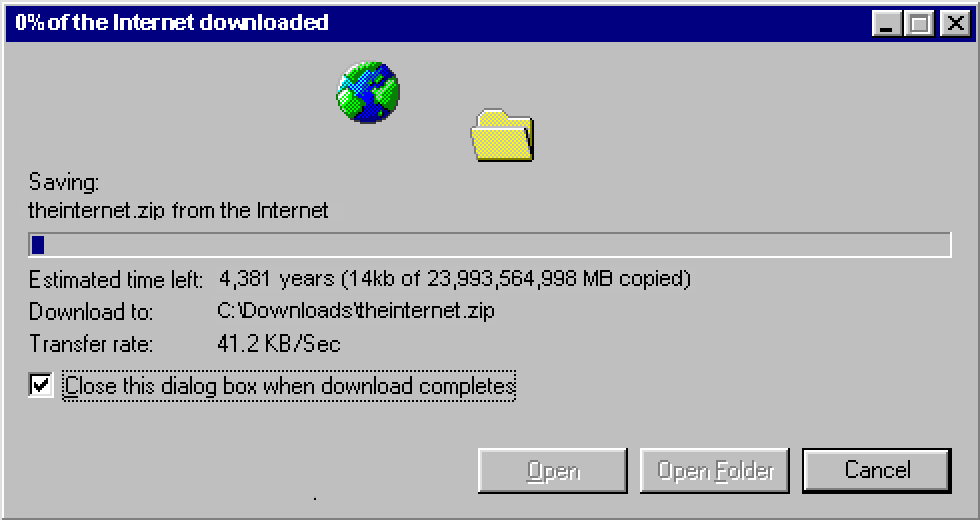
Bytes still have to travel
Back to the response
						ok: true
						status: 200
						statusText: ""
						headers: Headers {}
						url: "/api/pokemon"
						type: "basic"
						redirected: false
						body: ReadableStream
						bodyUsed: false
What is a stream?

A continuous stream of bytes
Credit: juancajuarez - stock.adobe.com

Buffer up some data, then handle it
Credit: Komarov Andrey - Fotolia
Simulated Slow Connection
import express from "express";
import path from "path";
import fs from "node:fs";

const app = express();
const port = 3000;

app.get("/api/pokemon", (req, res) => {
  res.status(200);
  res.setHeader("Access-Control-Allow-Origin", "*");
  res.setHeader("Content-Type", "application/json");

  // 209 KB
  const filePath = path.join(__dirname, "pokemon.json");
  const stream = fs.createReadStream(filePath, { encoding: "utf8" });

  stream.on("readable", () => {
    const intervalId = setInterval(() => {
      const chunk = stream.read(1);
      if (chunk !== null) {
        res.write(chunk);
      } else {
        clearInterval(intervalId);
        res.end();
      }
    }, 5); // 1 byte every 5 ms = 0.2KB/s
  });
});
Is this too slow?
pokemon.json
$3.5\text{x}$ this file every second
Fetching The Whole Thing
							const response = await fetch("/api/pokemon");
							const data = await response.json();
Time taken: 0s
How long will this take?
That's $17.5$ minutes!
Is there a better way?
Of course!
🌊 Streaming 🌊
Streaming
response.body is a
ReadableStream
This means we can consume the data as it reaches us
							const response = await fetch("/api/pokemon");
							const decoder = new TextDecoder("utf-8");

							let data = "";
							for await (const chunk of response.body) {
								data += decoder.decode(chunk);
							}
Time taken: 0s
Both methods will finish after 17-ish minutes
But the user is getting content for one of them!
streaming is awesome
Actually pretty clever
- We have the headers, so we can act on them right away
- The body isn't always finished (think Server-Sent Events)
- We can show something before everything is downloaded
Should we stream everything?
Of course not!
The regular way is fine for most things
Consider streaming if you have:
- Extra Large Payloads
- Extra Small Speeds
…or paginate, fetch a few things at a time
Thank you!
My name is Truls
Slides on github:
github.com/trulshj/presentation